Species numbers alone do not fully capture how ecosystems are changing. In a global study led by researchers from the German Centre for Integrative Biodiversity Research (iDiv), the Martin Luther University Halle-Wittenberg (MLU), and the Friedrich Schiller University Jena, scientists analysed long-term data from nearly 15,000 marine and freshwater fish communities. They found that fish food webs have changed substantially over recent decades, even in places where the number of species (species richness) has remained stable. Published in Science Advances, the study shows consistent shifts in species composition, body size, and feeding relationships, highlighting that changes in species traits such as body size and interactions can alter ecosystem structure without obvious changes in species richness.
Smaller fish, different food webs
The researchers combined time series data spanning up to 70 years with information on fish body size, diet, and trophic position. While overall species richness showed no consistent trend, species composition changed strongly over time. Across many ecosystems, communities increasingly consisted of smaller-bodied fish species.
“We often say “big fish eat small fish,” and in nature it’s true—it’s an ecological rule. Fish predators are usually larger than their prey, and this size difference determines who can eat whom. When the size of predators or prey changes, feeding relationships shift, reshaping food webs and how ecosystems function,” says first author and iDiv alumnus Dr Juan Carvajal-Quintero. He worked on the newly published study while working as a postdoctoral researcher at iDiv’s synthesis centre sDiv, and is now an Assistant Professor at Dalhousie University (Canada).
The study found that fish food webs have become more densely connected, with species interacting with a broader range of prey. This reflects an increase in generalist feeders – species that are less specialized in their diets. While the proportion of large top predators like sharks, goliath groupers, muskellunge, and marble trout declined, mid-level predators as well as primary consumers increased, reshaping the distribution of species across trophic levels.
“Together, these results indicate a widespread reorganization of fish food webs, affecting both their structure and function. Increased connectance may accelerate the spread of perturbations among species, yet it may also enhance overall buffering capacity against disturbances such as warming, eutrophication, or fishing pressure. As a result, the responses of future food webs to global change remain highly uncertain,” said Prof Ulrich Brose, research group head at iDiv and the University of Jena.
Food-web structure determines how effects propagate through an ecosystem. When large top predators are lost and generalist feeders with overlapping diets dominate, the consequences of human-driven pressures — warming, overfishing, nutrient loading — can ripple more widely across species.
Similar patterns across ecosystems worldwide
The researchers found similar trends in both marine and freshwater systems, across many regions of the world, suggesting these changes reflect broad, long-term reorganization rather than local responses. “No single study could reveal this. It’s only by synthesizing nearly 15,000 fish communities spanning decades and linking compositional changes to food-web theory that we can see how consistent and widespread this restructuring really is,” says senior author Prof Jonathan Chase, research group head at iDiv and the MLU.
The findings show that monitoring species richness alone may miss important aspects of biodiversity change. Tracking species traits and interactions provides additional insight into how ecosystems are reorganizing. Integrating food-web perspectives into biodiversity research and monitoring helps improve our understanding of ecosystem change and may support future conservation efforts.
The study was funded by the German Research Foundation (DFG; FZT-118), among others. Alumnus Dr Juan Carvajal-Quintero was a postdoctoral researcher at iDiv’s synthesis centre sDiv, which helps bring together existing but disparate data, methods, theories, and tools in new and sometimes unexpected ways.
Original publication
(Researchers with iDiv affiliation and alumni bolded)
Juan D. Carvajal-Quintero, Maria Dornelas, Lise Comte, Juliana Herrera-Pérez, Pablo A. Tedesco, Xingli Giam, Ulrich Brose, Jonathan M. Chase (2026). Degradation of fish food webs in the Anthropocene. Science Advances, DOI: 10.1126/sciadv.adu6540
Contact persons
Dr Juan Carvajal-Quintero
Alumnus of the German Centre for Integrative Biodiversity Research Halle-Jena-Leipzig – iDiv
Dalhousie University
E-mail: juan.carvajal@dal.ca
Prof Ulrich Brose
Head of the Theory in Biodiversity Science research group
German Centre for Integrative Biodiversity Research (iDiv) Halle-Jena-Leipzig
Friedrich Schiller University Jena
Phone: +49 341 9733205
E-mail: ulrich.brose@idiv.de
Prof Dr Jonathan Chase
Head of the Biodiversity Synthesis research group
German Centre for Integrative Biodiversity Research Halle-Jena-Leipzig – iDiv
Martin Luther University Halle-Wittenberg
Phone.: +49 341 9733120
E-Mail: jonathan.chase@idiv.de
Kati Kietzmann
Public Relations
German Centre for Integrative Biodiversity Research Halle-Jena-Leipzig – iDiv
Phone: +49 341 9739222
E-Mail: kati.kietzmann@idiv.de
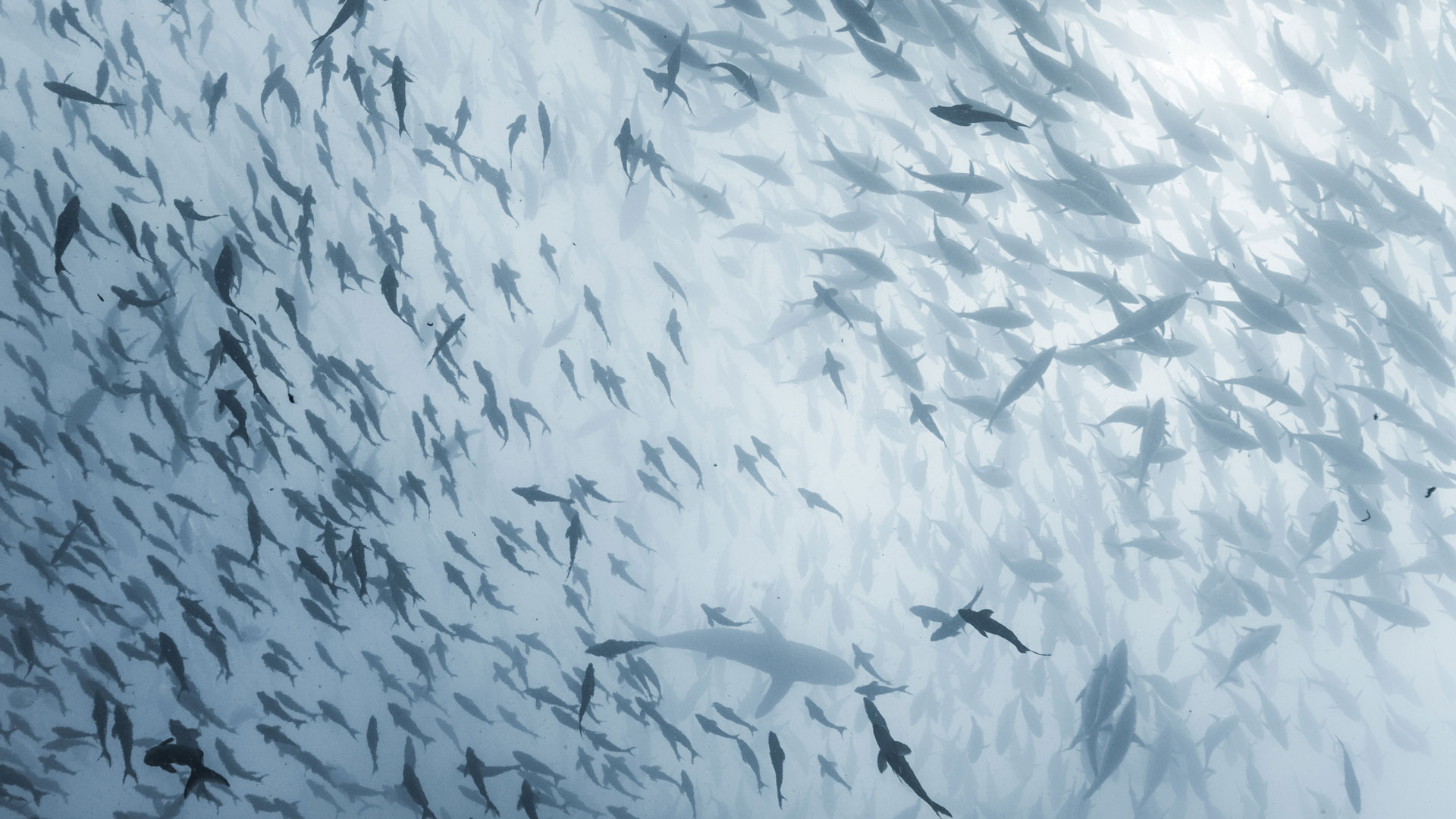
A school of fish swims alongside sharks. Predator–prey relationships are shifting as declines in large top predators and increases in smaller, more generalist species are reshaping fish food webs worldwide.
Please note: Use of the pictures provided by iDiv is permitted for reports related to this media release only, and under the condition that credit is given to the picture originator.