A new study published in Conservation Biology shows that geotagged social media photos can significantly improve biodiversity datasets, especially in regions underrepresented in global monitoring efforts.
Led by scientists from the German Centre for Integrative Biodiversity Research (iDiv), the Friedrich Schiller University Jena, the Helmholtz Centre for Environmental Research – UFZ, and Monash University, the team integrated Global Biodiversity Information Facility (GBIF) occurrence records with public images of the tawny coster butterfly (Acraea terpsicore) from Flickr and Facebook, and saw a 35% increase in total observations.
The combined dataset also significantly improved the accuracy of species distribution models, revealing range expansions in areas that models using only GBIF records had missed. Species distribution models are frequently used by researchers to estimate where species can live and how their ranges shift over time.
The enhanced models showed that social media data captured faster and broader range expansions, particularly in regions where formal monitoring was sparse. They also showed that GBIF-only records are underrepresented in areas with cooler maximum temperatures, lower rainfall, and higher elevations, environments that may prove critical for species survival under climate change.
“These additional records filled major gaps, especially in countries underrepresented in biodiversity databases,” explains first author and iDiv alumnus Dr Shawan Chowdhury of Monash University. “It’s a powerful reminder that conservation science can’t afford to ignore citizen observations. Social media isn’t just noise, it’s also data that can revolutionise our understanding of species distribution. And often, it’s the kind we need most.”
The promise and limits of biodiversity data from social media
The tawny coster is an ideal species for the researchers as it continues expanding beyond its native range in India, Bangladesh, and Sri Lanka into other south and southeast Asian countries. This ongoing expansion, combined with the species’ high visibility and recognisability, makes it especially suitable for detecting range shifts through public photographs and for assessing the value of social‑media data. Cryptic or taxonomically challenging groups — such as moths and beetles — appear far less often on public platforms, and social media would likely not be as helpful for these groups as with the tawny coster.
While the study showed that social media images can help improve biodiversity data, some level of expert review remains essential when relying on public images, as people may misidentify species or post photographs that are difficult to interpret.
Still, the authors argue that the records offer a reliable and scalable tool for tracking changes in species’ ranges in real time. Senior author Prof Dr Aletta Bonn, of UFZ, iDiv, and the University of Jena, says: “The study highlights the importance of citizen science for assessing rapid biodiversity change in response to climate change.”
People are already supporting this effort by documenting plants and animals with widely used apps such as iNaturalist or the German app Flora Incognita. Many of these observations eventually feed into global databases like GBIF, but as the study demonstrates, not all areas are covered. Community‑generated records, including those shared on social media, can help to provide a more complete and timely picture of biodiversity change as the planet warms.
Original publication
(Researchers with iDiv affiliation bolded)
Chowdhury, S., Hawladar, N., Roy, R. C., Capinha, C., Cassey, P., Correia, R. A., Deme, G. G., Di Marco, M., Di Minin, E., Jarić, I., Ladle, R. J., Lenoir, J., Momeny, M., Rinne, J. J., Roll, U., Bonn, A. (2026). Harnessing social media data to track a species range shift: A case study using the tawny coster butterfly. Conservation Biology. DOI: 10.1016/j.biocon.2025.111668
Contact
Dr Shawan Chowdhury
Monash University
Friedrich Schiller University Jena
Helmholtz Centre for Environmental Research – UFZ
German Centre for Integrative Biodiversity Research Halle-Jena-Leipzig – iDiv
E-Mail: Shawan.Chowdhury@monash.edu
Prof Dr Aletta Bonn
Helmholtz Centre for Environmental Research – UFZ
German Centre for Integrative Biodiversity Research Halle-Jena-Leipzig – iDiv
Friedrich Schiller University Jena
E-Mail: aletta.bonn@idiv.de
Christine Coester
Impact Unit
German Centre for Integrative Biodiversity Research Halle-Jena-Leipzig – iDiv
Telephone: +49 341 97 33197
E-Mail: christine.coester@idiv.de
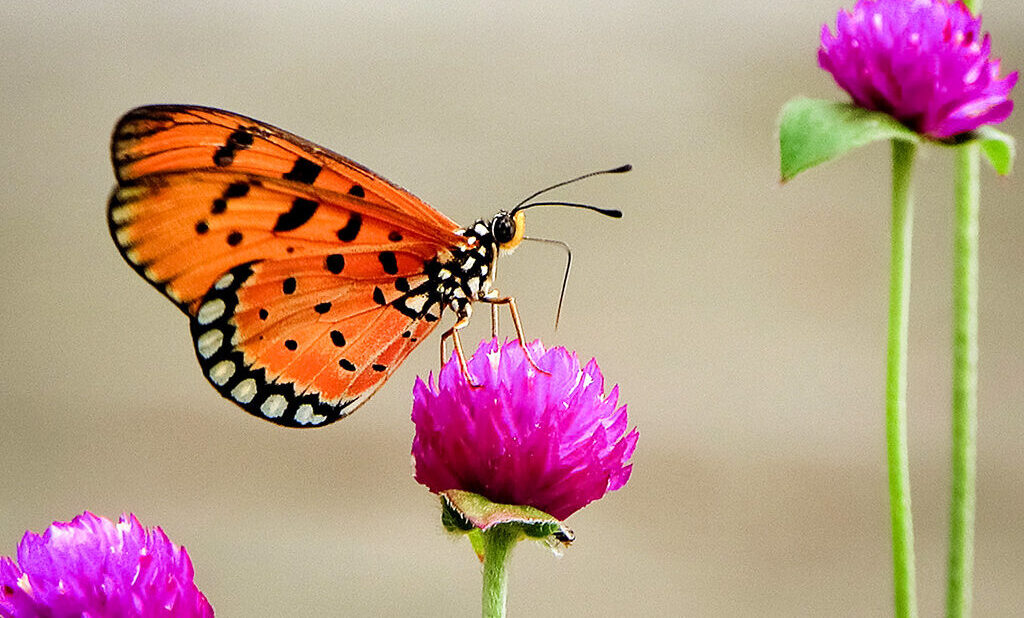
The tawny coster continues expanding beyond its native range in India, Bangladesh, and Sri Lanka into other south and southeast Asian countries.
Please note: Use of the pictures provided by iDiv is permitted for reports related to this media release only, and under the condition that credit is given to the picture originator.