By Dr. Sreetama Bhadra, former Postdoctoral Fellow at iDiv Synthesis Centre, now Junior Group Leader at Institute of Botany, Czech Academy of Sciences
How does the extraordinary diversity of life on Earth come to exist? In our new study, we looked at 110 million years of palm evolution across more than 2,600 species to understand how palms diversified. We discovered this diversity was shaped by visible plant features, genome size – the total amount of DNA in a cell – and allometry – the way different plant parts are physically linked as they evolve. The study was published in Proceedings of the Royal Society B and led by researchers at the German Centre for Integrative Biodiversity Research (iDiv) in collaboration with Naturalis Biodiversity Centre, and the Royal Botanic Gardens, Kew.
Palms are among the most recognisable plants in tropical rainforests. They include species with extraordinary features, such as the double coconut (Lodoicea maldivica), which produces the largest seed in the plant kingdom, and King raffia palm (Raphia regalis), which has the largest leaves among flowering plants. Palms have also gone through major bursts of species evolution over their long evolutionary history spanning 110 million years, producing the diversity of forms and species we see today. We wanted to know what helped drive these bursts of species formation.
We found that palms created new species faster when some of their features, like leaf size and plant height, changed faster over evolutionary time (i.e., millions of years). This suggests that rapid changes in such features have helped palms explore new ecological opportunities and contributed to their evolutionary success.
However, plant evolution does not work like building freely with Lego blocks. A palm cannot change its height, stem, leaves, fruits, and seeds independently of each other, because these features are physically (allometrically) connected. A change in one part of the plant can affect what is possible (or not) in another part.
Genome size also mattered. We found that larger genomes were linked to slower changes in plant height and stem diameter. This suggests that genome size may limit how quickly plant features can evolve, although the direct link between genome size and species formation was less clear.
Together, our findings show that evolution of palm biodiversity – and probably biodiversity in general – is not shaped by visible plant features acting alone. Instead, the formation of new species reflects complex interactions between plant features, allometry, and genome size. By bringing these processes together, our study provides a powerful new framework for understanding how Earth’s extraordinary biodiversity evolved.
Original publication
(Researchers with iDiv affiliation and alumnae bolded)
Sreetama Bhadra, Ilia J. Leitch, Sidonie Bellot, William J. Baker, Renske E. Onstein (2026). Trait evolution drives speciation through complex interactions between genome size, adaptation and allometry. Proceedings of the Royal Society B: Biological Sciences. 293: 20253116. https://doi.org/10.1098/rspb.2025.3116
Contact
Dr Sreetama Bhadra
Junior Group Leader, Plant Evolutionary Ecology
Institute of Botany, Czech Academy of Sciences
German Centre for Integrative Biodiversity Research Halle-Jena-Leipzig – iDiv
E-mail: sreetama.bhadra@gmail.com
Website: www.sreetamabhadra.com
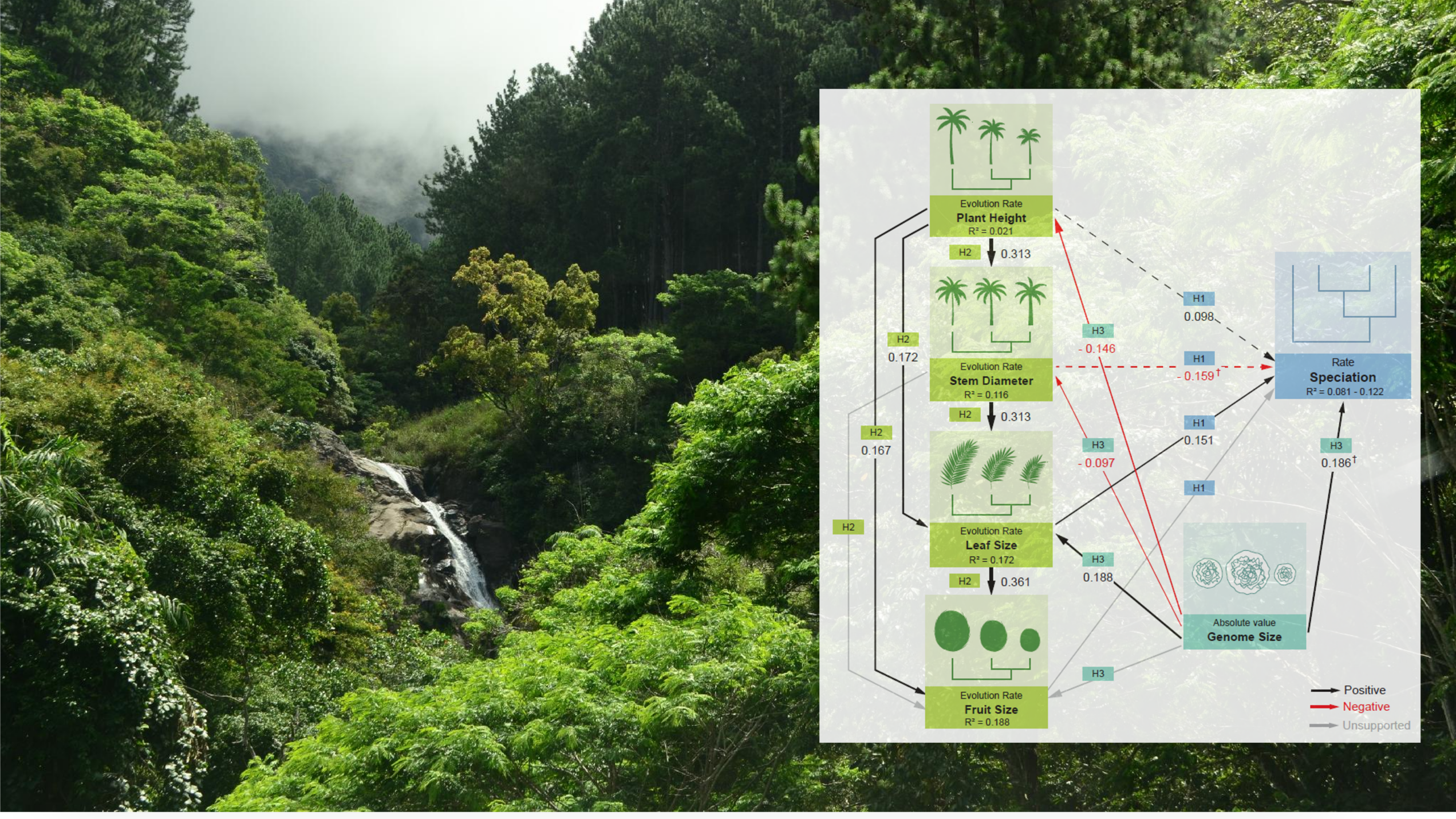
Biodiversity is shaped by visible plant features, genome size (i.e., the total amount of DNA in a cell), and allometry (i.e., the way different plant parts are physically linked as they evolve). Photo taken in Morapitiya–Runakanda Rainforest, Sri Lanka
Please note: Use of the pictures provided by iDiv is permitted for reports related to this media release only, and under the condition that credit is given to the picture originator.