Based on a press release by the Martin Luther University Halle-Wittenberg
The number of plant species in many ecosystems across Europe has grown rather than shrunk over the last 100 years. However, this is not necessarily cause for celebration as this local increase is primarily due to so-called generalists and non-native species, which compete with native species, according to findings published in Nature Communications.
After analysing more than 57,000 time series of plant biodiversity across multiple European habitats, the international research team led by researchers at the Martin Luther University Halle-Wittenberg (MLU) and the German Centre for Integrative Biodiversity Research (iDiv), also found that the overall number of species in Europe had not increased.
“It is well known that biodiversity is changing at the global level, with species being displaced or going extinct. However, these changes are not always so readily apparent at the local level, where the number of species may even increase initially,” explains Dr Stephan Kambach, an iDiv member and ecologist at MLU, who led the study alongside iDiv members Dr Ute Jandt and Professor Helge Bruelheide.
First Europe‑wide analysis of how local plant biodiversity has changed over the past century
Working with researchers from a total of 21 countries, the three scientists produced the first detailed Europe-wide analysis of how local plant biodiversity has changed over the past 100 years.
To do this, the team used more than 57,000 so-called vegetation-plot time series, in other words, systematic surveys of plant communities carried out repeatedly over a long period of time in the same location. The data was also categorised according to habitat and how it has changed over time; specifically, whether a habitat has remained stable, has changed naturally, or has been disrupted by human activity.
“Our analysis is the largest study to date on the changes to Europe’s local plant communities,” Bruelheide explains. “In addition to identifying general trends in various aspects of plant biodiversity, we have been able, for the first time, to provide detailed information about most European habitat types.”
Over the last century, the number of species has risen by an average of 0.2 per cent per year in Europe. However, there were significant variations depending on the habitat. The biggest changes were observed in wetlands and marshlands, particularly where these habitats had been disturbed or overgrown by trees and shrubs. The changes were much less pronounced in grasslands.
“We saw that, on the local scale, there are actually more plant species than there used to be. But on closer inspection, these were mainly generalists and non-native species. This increase is therefore not a sign of an intact habitat but often an indication of precisely the opposite,” Kambach says.
Adaptable generalists have the ability to displace native specialist and rare plants over the long term. This is supported by another finding: the total number of species found across all areas of a given habitat type in Europe has not increased, despite the arrival of new species. “Species displacement and extinction are slow processes that can only be observed and documented over long periods of time,” Kambach adds. If the trends observed by the researchers continue into the future, species numbers could decline even in areas where populations are currently stable.
“Our study…highlights how important the continuous, Europe-wide monitoring of local plant communities is,” says Jandt, adding it would not have been possible without the decades of data collected by European botanists.
Jandt coordinates the Europe-wide project “MOTIVATE” at MLU. The project is funded by the European Commission and various national research funding bodies as part of the Biodiversa+- partnership. Project partners are from Rostock (Germany), Oulu (Finland), Brno (Czech Republic), Vienna (Austria), Oviedo (Spain), as well as Bologna and Rome (Italy).
Original publication
(Researchers with iDiv affiliation and alumni bolded)
Kambach, S., Jandt, U., Acosta, A. T. R., Álvarez‑Martínez, J. M., Axmanová, I., Bazzichetto, M., Bergmeier, E., Bernhardt‑Römermann, M., Biurrun, I., Bonari, G., Carboni, M., Carlucci, M. B., Carranza, M. L., Cerabolini, B. E. L., Chiarucci, A., Chytrý, M., Damasceno, G., Dengler, J., De Sanctis, M., Divíšek, J., Dolezal, J., Dullinger, S., Essl, F., Friesová, K., Fontana, V., Garbolino, E., Glaser, M., González‑Robles, A., Güler, B., Hähn, G. J. A., Hájek, M., Hruska, T., Illa, E., Jansen, F., Jansen, S., Jentsch, A., Jiménez‑Alfaro, B., Kissling, W. D., Knollová, I., Losapio, G., Liu, U., Lenoir, J., Lens, F., Lenzner, B., Perea Martos, A., Méndez, L., Messier, J., Mori, A. S., Napoleone, F., Norum, R., Novakovskiy, A., Onstein, R., Pakeman, R. J., Peñuelas, J., Petřík, P., Pielech, R., Pinho, B. X., Poschlod, P., Rašomavičius, V., Roscher, C., Rossi, C., Sabatini, F. M., Sandel, B., Schellenberger Costa, D., Schmidt, W., Sheremetiev, S., Shovon, T. A., Spasojevic, M. J., Swenson, N. G., Swacha, G., Tarifa, R., Tichý, L., Tomaselli, M., Valdés, A., Van Meerbeek, K., Vandvik, V., Vassilev, K., Večeřa, M., Weiher, E., Wohlgemuth, T., Bruelheide, H. (2026). Habitat-specific trends in taxonomic, functional, and phylogenetic diversity in European plant communities over a century. Nature Communications. DOI: https://doi.org/10.1038/s41467-026-72112-5
Contact
Dr Stephan Kambach
Martin Luther University Halle-Wittenberg
German Centre for Integrative Biodiversity Research Halle-Jena-Leipzig – iDiv
Telephone: +49 345 55 26289
E-Mail: stephan.kambach@botanik.uni-halle.de
Christine Coester
Impact Unit
German Centre for Integrative Biodiversity Research Halle-Jena-Leipzig – iDiv
Telephone: +49 341 97 33197
E-mail: christine.coester@idiv.de
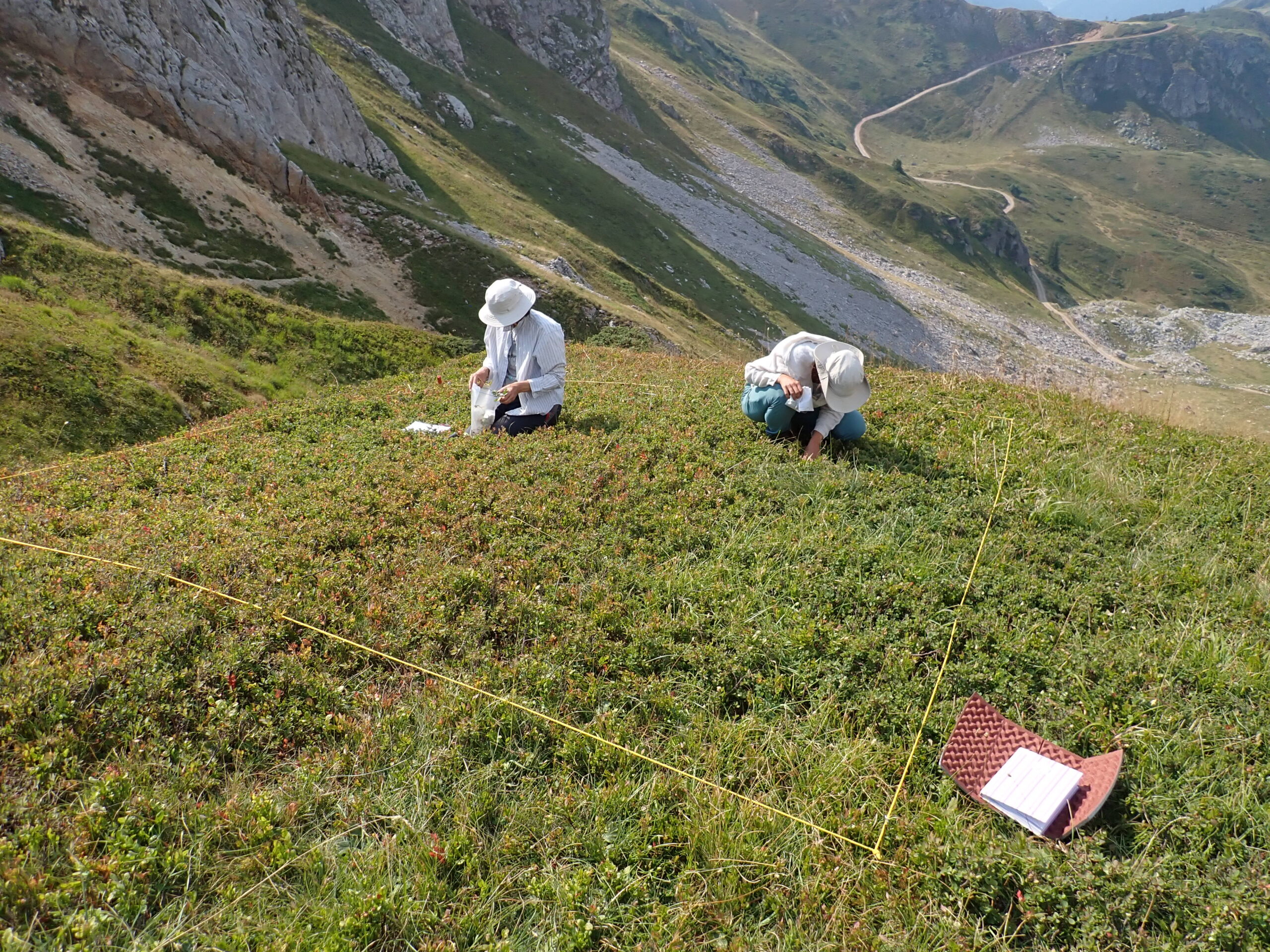
The study examined biodiversity across many regions of Europe. In this picture, researchers are conduction research in the Bjelasica Mountains in Montenegro.
Please note: Use of the pictures provided by iDiv is permitted for reports related to this media release only, and under the condition that credit is given to the picture originator.