This text is based on a press release by the University of Leipzig
Leipzig University has secured funding from the German Research Foundation (DFG) for the new Collaborative Research Centre (CRC) “Biodiversity Buffers for Climate Extremes” (BBCe), together with its research partners. Several iDiv researchers are part of the interdisciplinary consortium, which will investigate under what conditions biodiversity can buffer the effects of climate extremes and how changes in biodiversity, in turn, affect weather and climate. The DFG will fund the CRC for the next four years.
The increase in climate extremes and rapid changes in biodiversity are among the major challenges of our time. These two developments are closely intertwined: heatwaves and droughts, for example, can adversely impact biodiversity, while biodiversity loss can make ecosystems less resilient to such extremes. Through feedback mechanisms between ecosystems and the atmosphere, these changes could in turn intensify climate extremes. Understanding these interactions requires studying climate and biodiversity together.
A key aim of the new CRC is to bring together researchers from biology, Earth system science, climate science, meteorology and other disciplines to investigate feedback mechanisms between biodiversity and climate extremes. The researchers had previously called for such interdisciplinary collaboration in the journal Nature and identified key gaps in existing research in a separate paper. Their goal is to break new ground at the interface between biodiversity research and climate science, advancing our understanding of the interconnected effects of biodiversity change and climate extremes.
Professor Miguel Mahecha, iDiv member and spokesperson-designate for the BBCe Collaborative Research Centre, stresses the importance of an interdisciplinary approach to addressing these complex questions: “To truly understand and predict how biodiversity patterns and climate extremes evolve, we need to bring together ecological and climatological perspectives. This requires a common language, collaboration across disciplines, new observational data, new methods drawing on artificial intelligence and, above all, advances in Earth system modelling,” he says.
The BBCe Collaborative Research Centre will investigate, for example, how the structural, taxonomic and functional diversity of vegetation can help buffer the impacts of such events. How does greater biodiversity help maintain ecosystem functioning in the face of climate extremes? Conversely, how might a decline in biodiversity destabilise ecosystems? These are two key questions the researchers will address. But the CRC will go a step further, asking whether changes in biodiversity also affect atmospheric processes and, consequently, extreme events such as heatwaves.
The BBCe Collaborative Research Centre will combine observations and experiments at scales ranging from local to continental with data-driven and dynamic modelling approaches. “Our long-term goal is to lay the foundations for creating resilient landscapes that can withstand the effects of climate change. By unravelling the complex relationships between biodiversity and climate extremes, we can develop strategies to safeguard both ecosystems and human well-being,” Mahecha explains.
Led by Leipzig University, the CRC also involves the University of Freiburg and the University of Potsdam. Other partners include the German Aerospace Center (DLR), the German Centre for Integrative Biodiversity Research (iDiv) Halle-Jena-Leipzig, the Helmholtz Centre for Environmental Research (UFZ), the Julius Kühn Institute (JKI), the Leibniz Institute for Tropospheric Research (TROPOS) and the Max Planck Institute for Biogeochemistry (MPI-BGC).
The following iDiv researchers are involved in the new Collaborative Research Centre (listed alphabetically):
· Ana Bastos (UL)
· Daniel Doktor (UFZ)
· Nico Eisenhauer (UL)
· Hannes Feilhauer (UL, UFZ)
· Claudia Guimarães-Steinicke (UL)
· Johannes Quaas (UL)
· Nadja Rüger (UL)
· Beatriz Sánchez-Parra (UL)
· Susanne Dunker (UFZ)
· Sebastian Wieneke (UL)
· Alexandra Weigelt (UL)
· Christian Wirth (UL, MPI-BGC)
· Miguel Mahecha (UL, UFZ)
Contact
Professor Miguel Mahecha
Leipzig University
German Centre for Integrative Biodiversity Research – Halle, Jena, Leipzig (iDiv)
Phone: +49 341 97-32801
Email: miguel.mahecha@rsc4earth.de
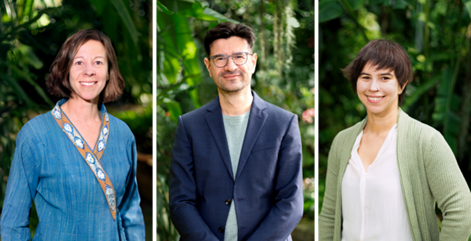
The designated spokesperson Prof. Miguel Mahecha (Environmental Data Science and Remote Sensing, center), and the deputy spokespersons Prof. Heike Kalesse-Los (Arctic Climate Change, left) and Prof. Ana Bastos (Land-Atmosphere-Interactions, right) form the interdisciplinary spokespersons-board.
Please note: Use of the pictures provided by iDiv is permitted for reports related to this media release only, and under the condition that credit is given to the picture originator.