Based on a press release by the University of Waikato, New Zealand
Healthy ecosystems depend on more than just having lots of species – they rely on the complex relationships between plants, prey and predators, according to new international research led by the University of Waikato and the German Centre for Integrative Biodiversity Research (iDiv).
Published in the journal Nature, the study found that ecosystems with greater diversity of species – and particularly a greater diversity of predators – function more effectively, helping maintain natural processes that people rely on, such as pest control, climate regulation and ecosystem stability.
Food webs sustain ecosystem functioning
Lead author and iDiv alumnus Dr Andrew Barnes from the University of Waikato says ecosystems are powered by the relationships between species – who eats who, how energy moves through the food web and the important role predators play in keeping everything in balance.
“When predators disappear through habitat loss, pollution or climate change, those effects can ripple through an entire ecosystem and weaken important functions,” Barnes says.
A global analysis across ecosystems
The research found that predators – from soil mites to sharks – are vital to the functions of ecosystems, which humanity relies on. Working with researchers from more than 20 institutions worldwide, the group examined more than 300 food webs from oceans, lakes, streams and soils around the world and found that there was up to 70 times more predation when ecosystems had a diverse range of species.
The study is the most comprehensive to date examining how biodiversity influences ecosystem functioning across entire food webs rather than focusing on a single group of organisms.
Complexity matters
“Species do not operate in isolation; ecosystems function through networks of interactions,” says senior author Dr Benoit Gauzens from iDiv and the Friedrich Schiller University Jena. “To understand and predict the consequences of biodiversity change, conservation must go beyond preventing species extinctions and also protect the ecological relationships that keep ecosystems productive and resilient.”
Original publication
(Researchers with iDiv affiliation and alumni bolded)
Barnes, A. D., Brose, U., Eisenhauer, N., Berti, E., Brauns, M., Eggert, S. L., Garcia-Callejas, D., Giling, D. P., Hall, R. O., Hines, J., Jochum, M., Korobushkin, D. I., Kortsch, S., Kratina, P., Manca, M., Mor, J.-R., Nordström, M. C., O’Gorman, E. J., Ott, D., Perkins, D. M., Rosenbaum, B., Saifutdinov, R. A., Saito, V. S., Tanentzap, A. J., Vinagre, C., & Gauzens, B. (2026). Food web complexity underlies biodiversity effects on ecosystem functioning. Nature. DOI: 10.1038/s41586-026-10710-5
Contact
Dr Andrew Barnes
Alumnus of the German Centre for Integrative Biodiversity Research Halle-Jena-Leipzig – iDiv
Now at the University of Waikato, New Zealand
phone: +64 7 838 4460
email: andrew.barnes@waikato.ac.nz
webpage: https://profiles.waikato.ac.nz/andrew.barnes
Dr Volker Hahn
Head of Impact and Spokesman
German Centre for Integrative Biodiversity Research Halle-Jena-Leipzig – iDiv
phone: +49 341 97 33154
email: volker.hahn@idiv.de
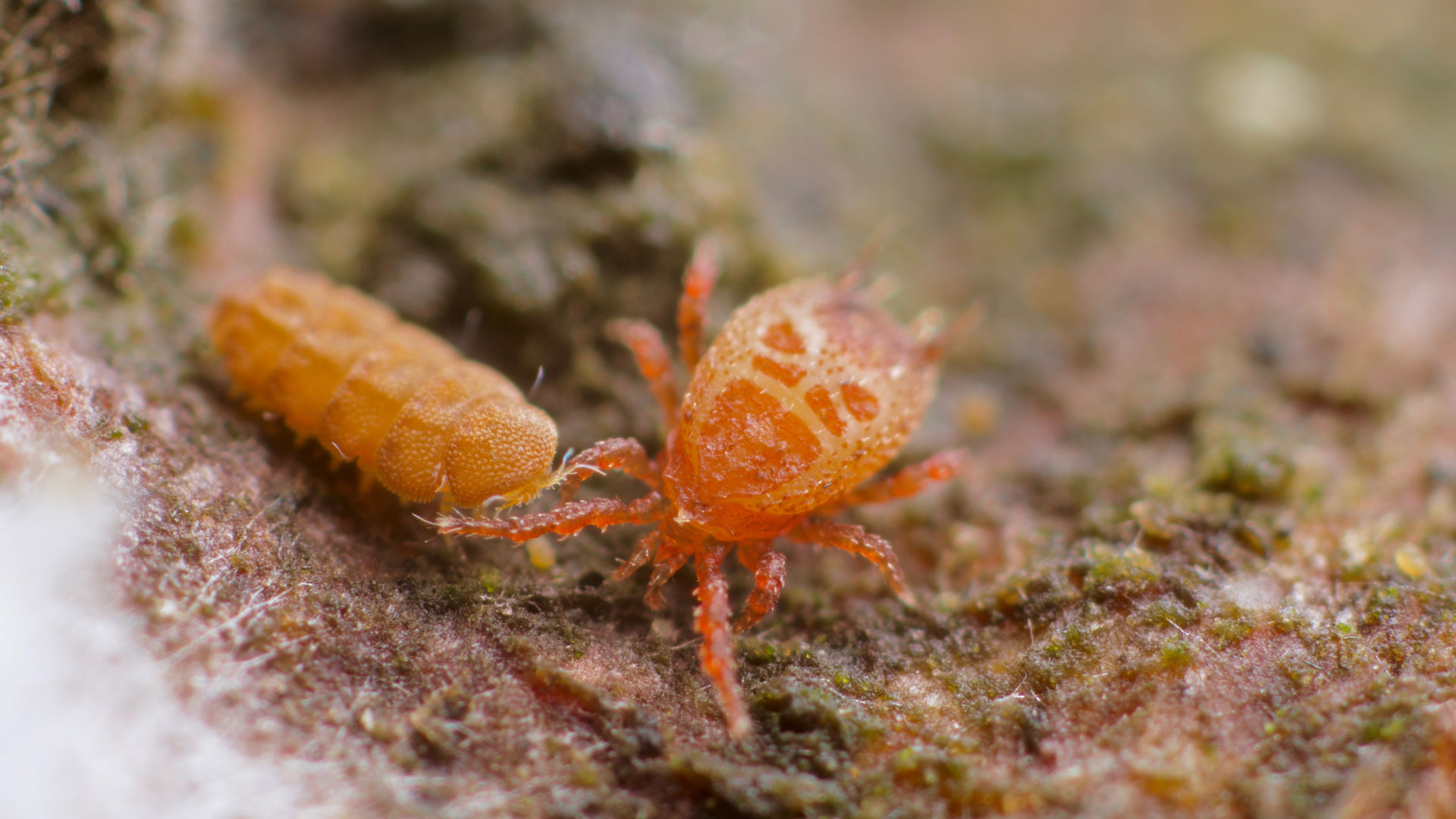
Food webs shape how ecosystems function. The photo shows a predatory soil mite and a pauropod that feeds on fungi and decaying organic matter.
Please note: Use of the pictures provided by iDiv is permitted for reports related to this media release only, and under the condition that credit is given to the picture originator.