By Dr Gavin Stark, German Centre for Integrative Biodiversity Research and Martin Luther University Halle-Wittenberg
How can conservationists help damaged ocean ecosystems recover and thrive with less human intervention? In a new paper published in Conservation Science and Practice, my research team and I propose eight principles for marine rewilding, an approach that helps depleted populations and habitats recover, restores the connections among them, and reduces human pressures, so ecosystems can increasingly regulate themselves. Drawing on published research from land and sea, the principles address how species interact and move between habitats, how ecosystems respond to climate change and pollution, and how to manage species that disrupt recovery. A major objective of our work was to connect ecological recovery with the knowledge and needs of people who depend on the oceans.
As with rewilding on land, bringing back key species can help marine ecosystems recover by restoring the interactions that shape food webs and habitats. Sea otters beautifully illustrate how this can work. They eat sea urchins, which graze on kelp. When sea otters are reintroduced, they can reduce urchin grazing and help kelp forests recover. In turn, these underwater forests provide shelter and food for other marine life, including fish and crabs. Bringing back one species can therefore have effects across an ecosystem. We wanted to understand how relationships like these could guide marine rewilding more broadly.
Connections between habitats also matter. Many marine species move between environments during their lives, using some areas to feed and others for breeding or shelter. Recovery therefore depends on what happens both within a restored area and beyond its boundaries. Our framework encourages projects to consider these wider connections when deciding where and how to act. Marine pollution and invasive or overabundant species can disrupt recovery even after habitats are restored, so projects should assess these pressures, manage them where needed, and monitor how the ecosystem responds.
People are central to this process. We argue that fishers, Indigenous peoples, and other coastal communities should help shape rewilding from the outset. Their knowledge can guide restoration, while their involvement helps identify potential conflicts, such as when returning wildlife affects fishing. For these efforts to last, communities need an ongoing role in decisions, alongside clear rules, ways to resolve conflicts, and reliable support across the organizations that manage the sea. Indigenous governance and rights must also be respected. Decisions should consider local livelihoods and how the benefits and costs of recovery are shared.
In our paper, we also suggest measuring success by whether natural processes recover and persist as conditions change. Monitoring can help managers decide when to adjust their actions and when to step back as ecosystems become more self-sustaining. Overall, our framework offers a shared starting point for planning marine rewilding projects and assessing progress. The next step is to apply and evaluate the principles in different settings. By connecting ecological recovery with community priorities, we aim to help restoration support marine life, local livelihoods, and the coastal protection that healthy ocean ecosystems provide.
Publication
Stark, G., Joosten, G. G., Cornerier, A., & Schwarz, R. (2026). Marine rewilding principles as a guiding framework for large-scale ecosystem restoration. Conservation Science and Practice, e70396. DOI: 10.1111/csp2.70396
Contact
Dr Gavin Stark
German Centre for Integrative Biodiversity Research Halle-Jena-Leipzig – iDiv
Institute of Biology, Martin Luther University Halle-Wittenberg
E-mail: gavin.stark@idiv.de
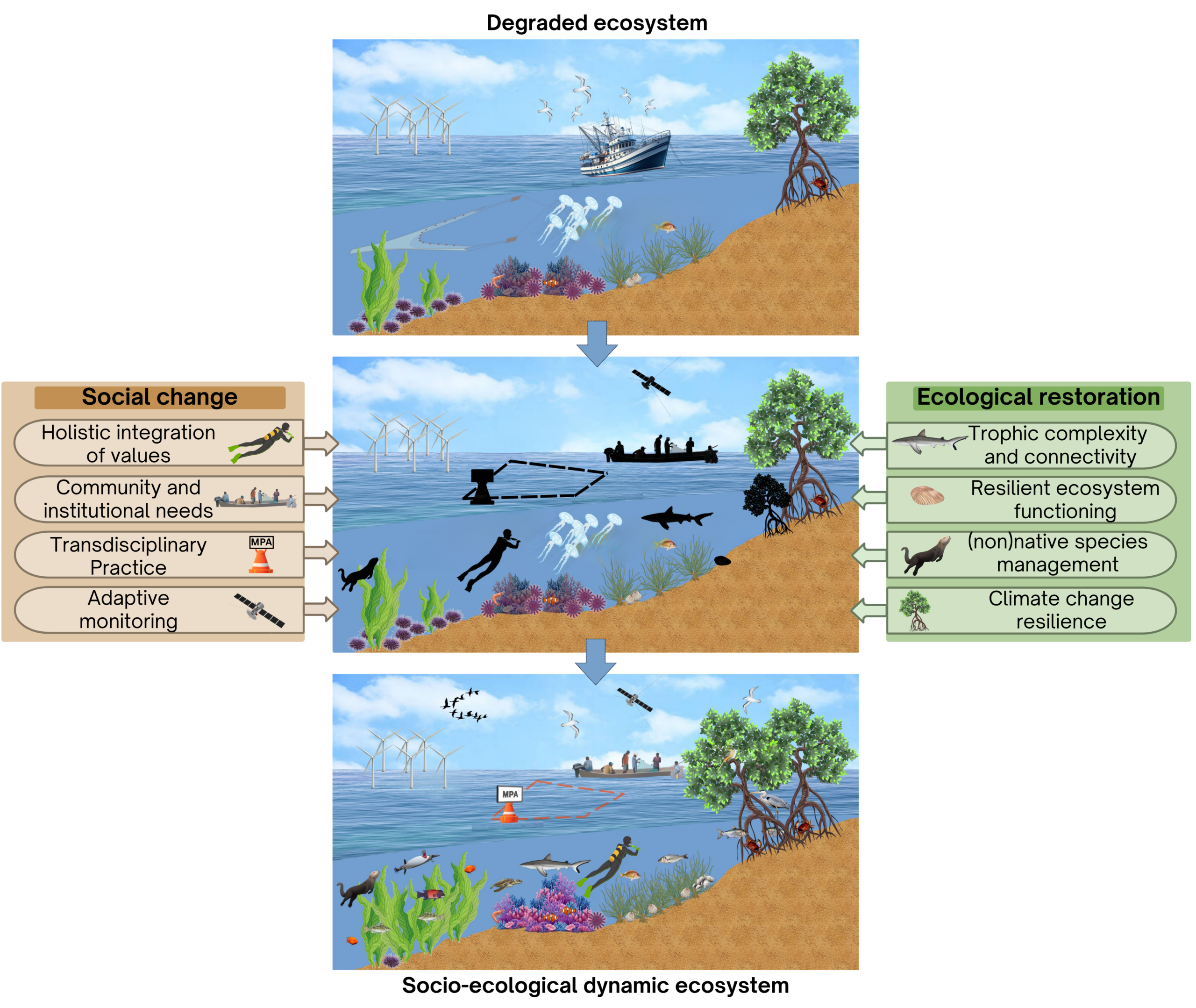
Marine rewilding brings ecological recovery together with community involvement and ongoing monitoring. This illustration shows the proposed pathway toward a self-sustaining, diverse marine ecosystem.
The published article is licensed under Creative Commons Attribution 4.0. Retain the creator credit, publication reference, and licence link. The accompanying image reproduces the complete published figure without changes.