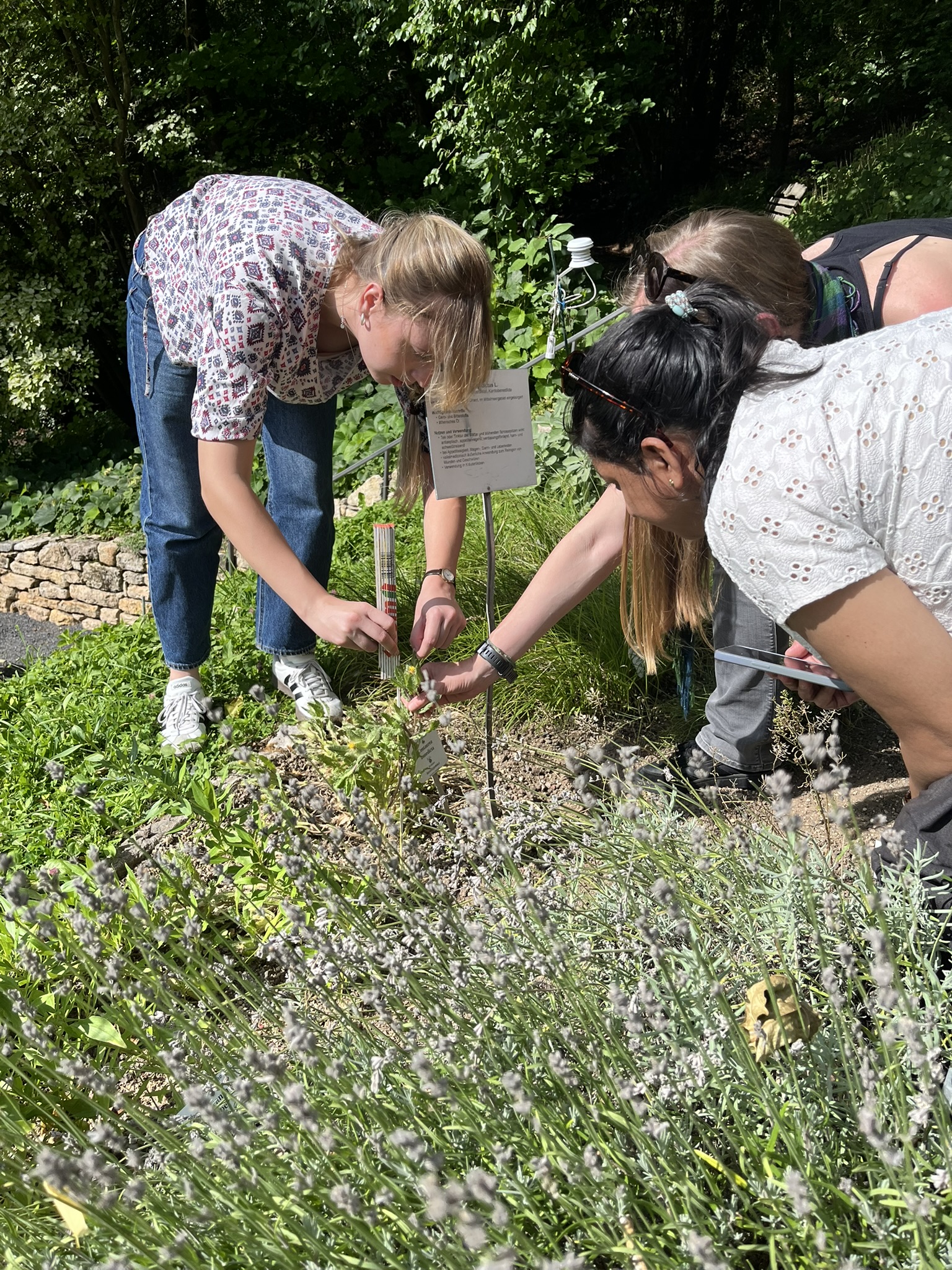
Data Collection in the Botanical Garden
This year’s iDiv Summer School brought together 12 young scientists from 8 countries to work with living plants and specimens from Leipzig’s and Jena’s botanical gardens and the Herbarium Haussknecht in Jena.
The Summer School focused on hands-on learning. Participants collected data on plant origins, functional traits, and phenological stages, working with species from a wide range of taxonomic groups. They combined their own observations with existing datasets and analysed the data using R before presenting and discussing their results. The practical sessions were complemented by lectures and discussions, providing insights into the ecological potential of botanical gardens, herbaria, and other biological collections.
The course was led by Solveig Franziska Bucher, Sebastian Gebauer, and Robert Rauschkolb, who shared their expertise in collection-based biodiversity research, functional traits, phenology, and digital collectomics.
Additional contributions came from Dr Franziska M. Willems (Philipps University Marburg) on spatial modelling approaches in plant phenology; Prof. Dr Niek Scheepens (Goethe University Frankfurt) on seed banks as research infrastructures and their potential for studying rapid evolution in response to climate change; and Dr Matthias Körschens (Senckenberg Institute of Plant Form and Function, Jena) on modern AI approaches for analysing biological collections.
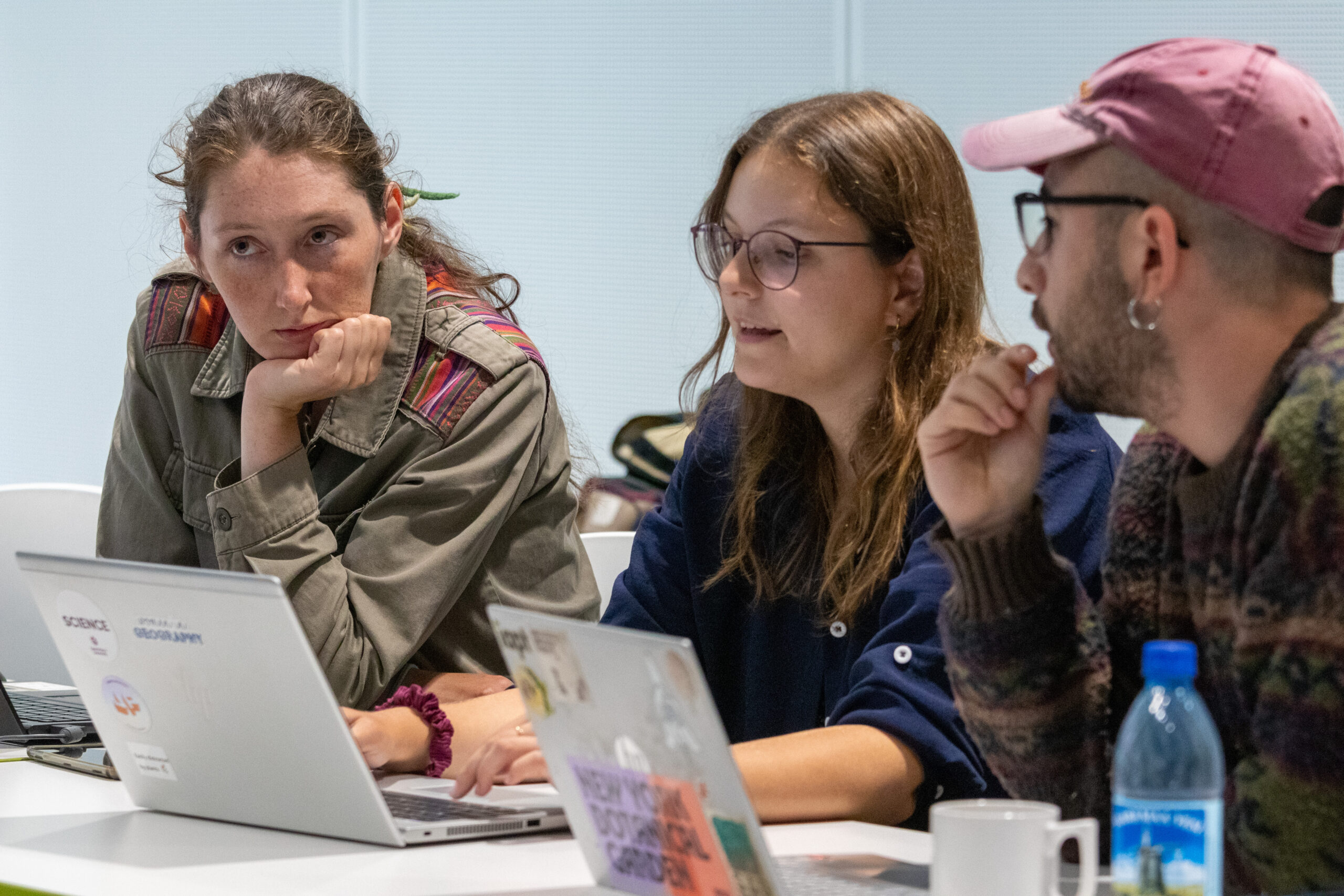
Group exercices at iDiv
The Summer School offered not only an opportunity to gain practical and analytical skills, but also time for exchange and networking among the participants.
Given potential changes to the iDiv Summer School format, there are currently no plans to offer a summer school in 2027. However, if you are interested in organising a summer school and are willing to explore funding options, please contact Nicole Sachmerda-Schulz. (nicole.sachmerda-schulz@idiv.de)
Testimonials
“The iDiv Summer School was a great learning experience. I gained useful knowledge about herbarium specimens and plant collections and learned practical methods for measuring plant traits. I also enjoyed exchanging ideas and connecting with participants from different backgrounds.” – Aklilu Wodebo Wola, Martin Luther University Halle-Wittenberg
“I found the iDiv Summer School a very enjoyable and well-organised experience. The small group size created the perfect balance between exchange, diverse perspectives, and individual support. I particularly appreciated the personal guidance throughout the week and the hands-on exercises, which allowed us to directly apply what we had learned. The programme was varied and engaging without ever feeling stressful or overloaded. Our group was incredibly open and welcoming, and I was genuinely sad when the week came to an end.” – Helena Bertelmann, Technical University Dresden
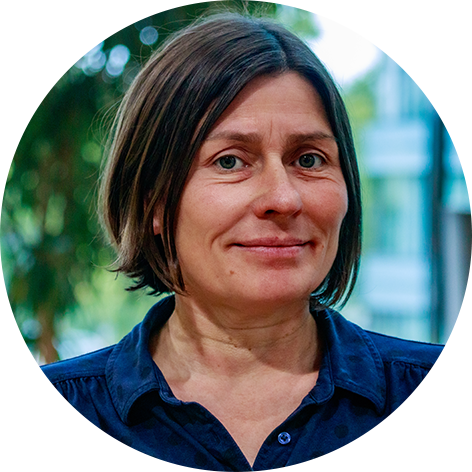
Beate Horn
Administrative Assistant
Phone: +49 341 9733126
Email: beate.horn@idiv.de
Full profile

Dr Nicole Sachmerda-Schulz
Head of the Education Unit, Scientific Manager Graduate School, and iDiv Counsellor
Phone: +49 341 9733125
Email: nicole.sachmerda-schulz@idiv.de
Full profile